


Fort Worth Custom Pool Builder Watercrest Pools
Fort Worth's Custom Pool Builder for Cowtown's Old-Money Estates and Gated Golf Enclaves
Fort Worth doesn’t sell itself the way Dallas does. It’s a city that grew up around cattle and rail money instead of banking towers, and that history still shapes what “luxury” looks like here: century-old estates on tree-canopied lots west of downtown, a guard-gated golf community wrapped around Benbrook Lake, and craftsman-era neighborhoods where a five-year-old custom build sits next to a 1920s bungalow on the same block.
Watercrest Pools has spent 18+ years and 500+ completed projects learning that Fort Worth’s luxury market isn’t one identity, it’s several distinct ones, and each calls for a different design instinct.
Fort Worth rewards builders who know the ground they are working on. Here that means understanding how pool installation behaves on a Rivercrest lot with protected trees, and what a Westover Hills lot asks of a design before anything is drawn.
Why Choose Watercrest As Your Fort Worth Custom Pool Builder
- We understand Fort Worth’s split personality. A pool for a Rivercrest estate near a century-old country club has to solve different problems than one for a new custom build on a Monticello infill lot. Our design team treats those as genuinely different projects, not the same template with a different address.
- Local soil and site knowledge that goes beyond generic DFW clay messaging. Fort Worth sits at the boundary of Blackland Prairie clay to the east and Cross Timbers limestone and rocky formations to the west, and we know which excavation and engineering approach a given neighborhood actually needs.
- A design studio just up the road in Southlake, meaning faster consultations and a team that already knows Tarrant County’s permitting relationships.
- HOA and architectural review fluency, from Mira Vista’s guard-gated country-club standards to the tree-preservation sensitivity that comes with building on a historic Berkeley Place or Park Hill lot.
Fort Worth homeowners comparing pool companies will find no shortage of options, and a good many of them are volume operations answering to out-of-state ownership. Watercrest is not. We are locally and privately owned, and our senior builders carry no more than ten active projects at a time. When you are weighing pool contractors for a build that will shape your backyard for the next twenty years, that difference in attention is the one worth measuring.
What Sets Watercrest Apart In Fort Worth
Watercrest is privately and locally owned, not a builder that’s sold to corporate or private-equity ownership, and that shows up directly in how projects are staffed. Our 12 team members bring 50+ combined years of DFW pool-building experience, and our senior builders cap their active projects at any given time so a Fort Worth client gets genuine attention rather than a spot in an assembly line. We’ve completed 500+ custom pools across the Metroplex since 2007, and Fort Worth’s mix of century-old estate lots and brand-new custom infill is exactly the kind of range that rewards a builder who’s actually built in both conditions before.
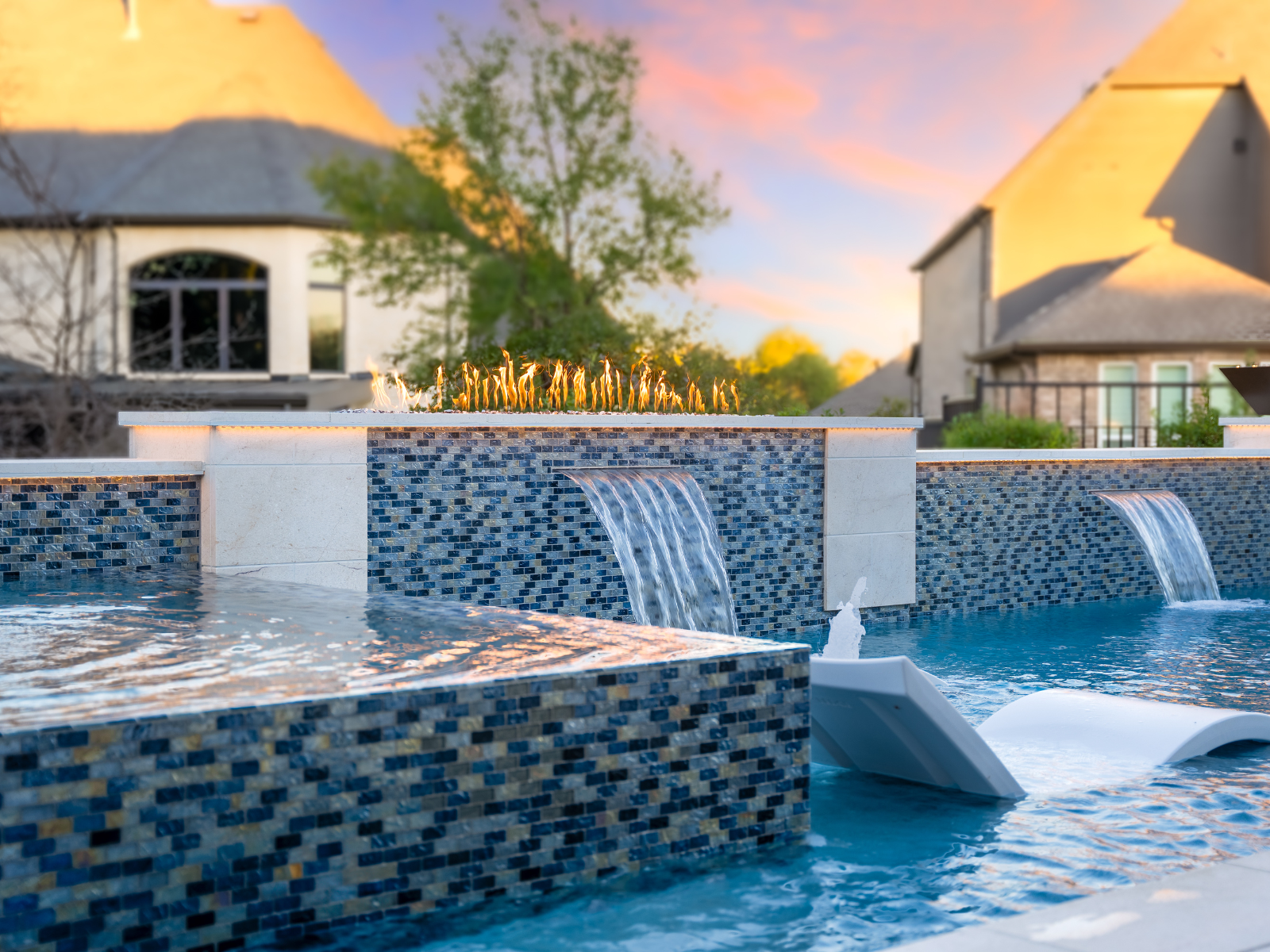
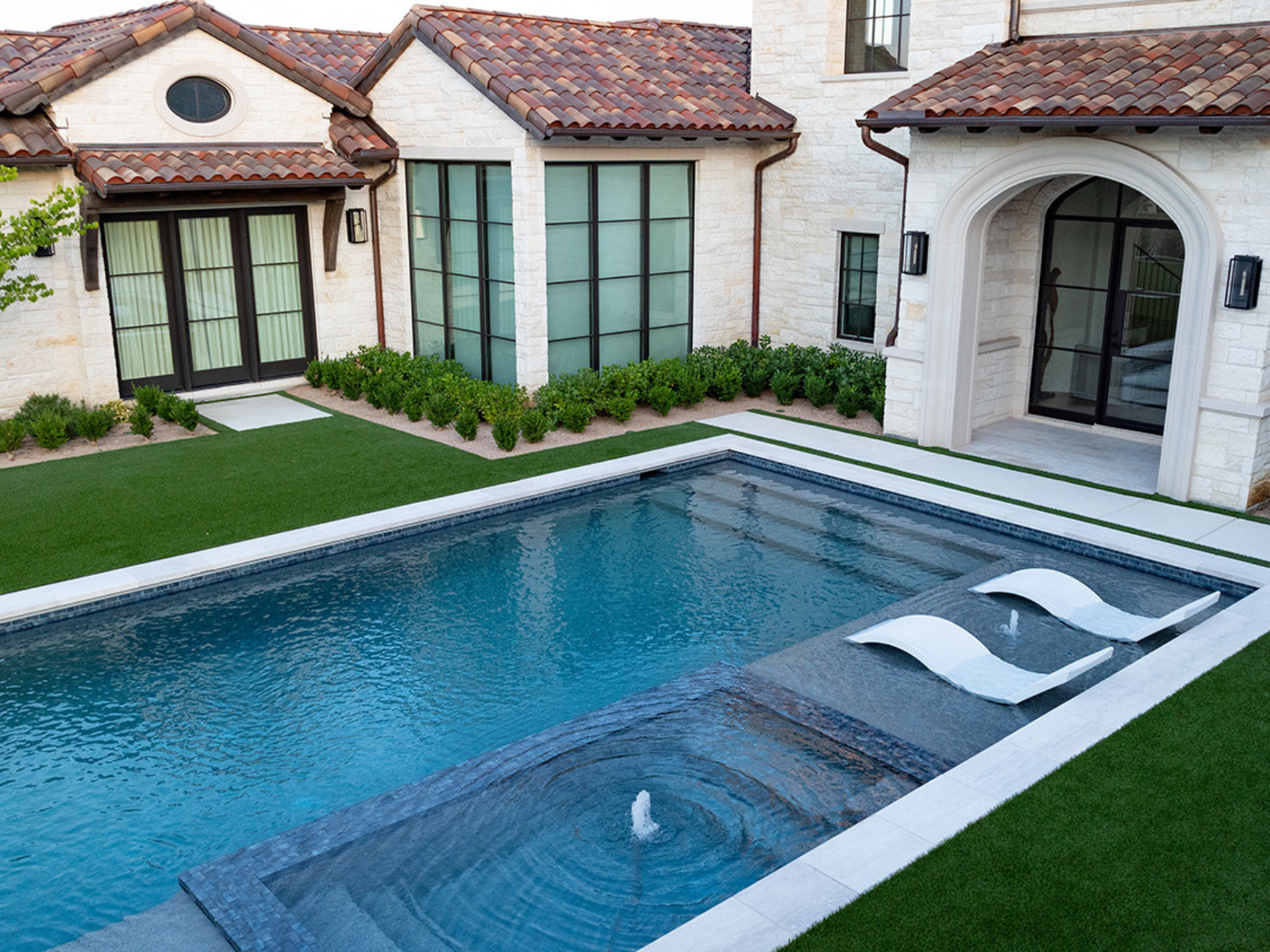
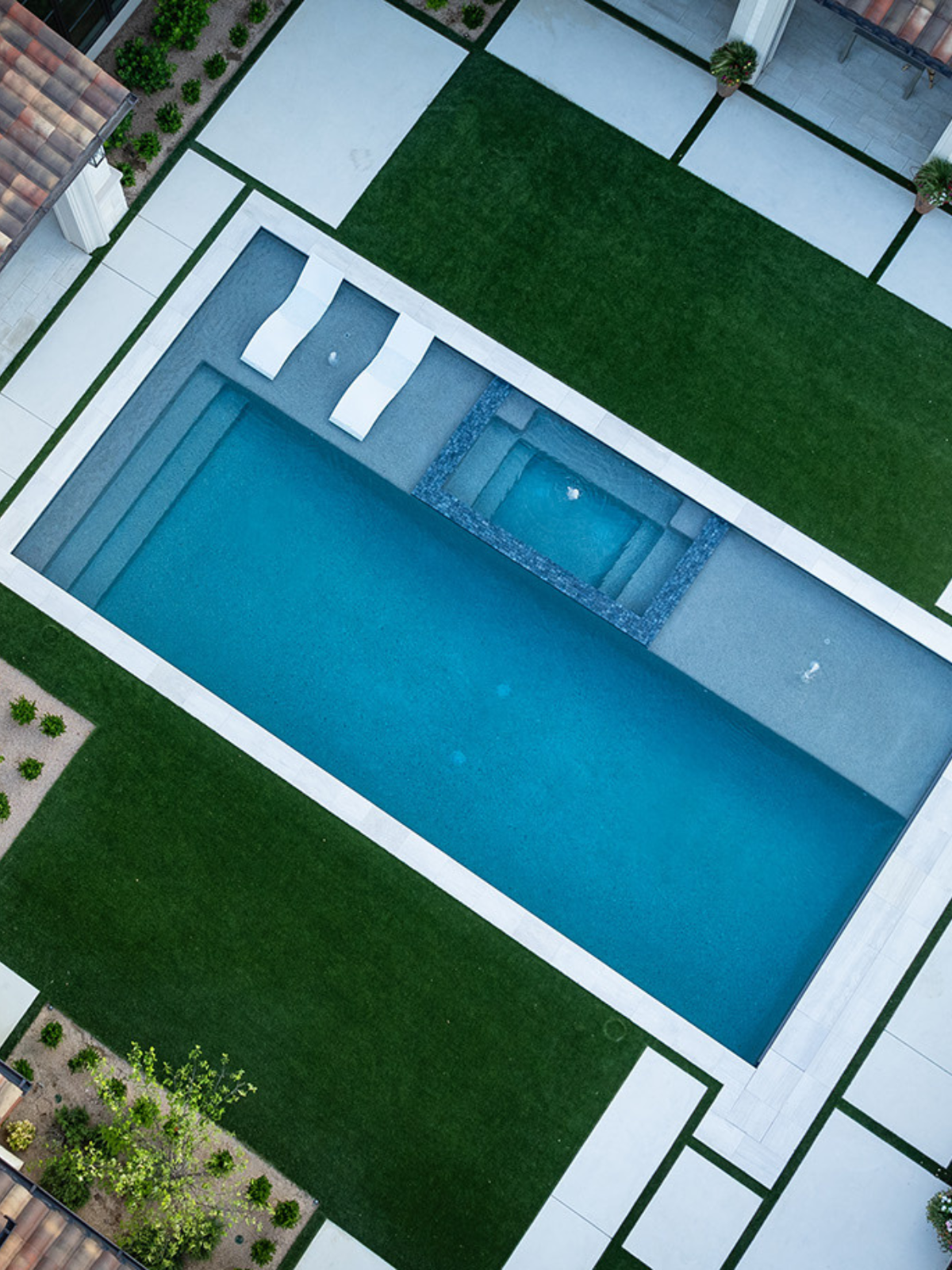
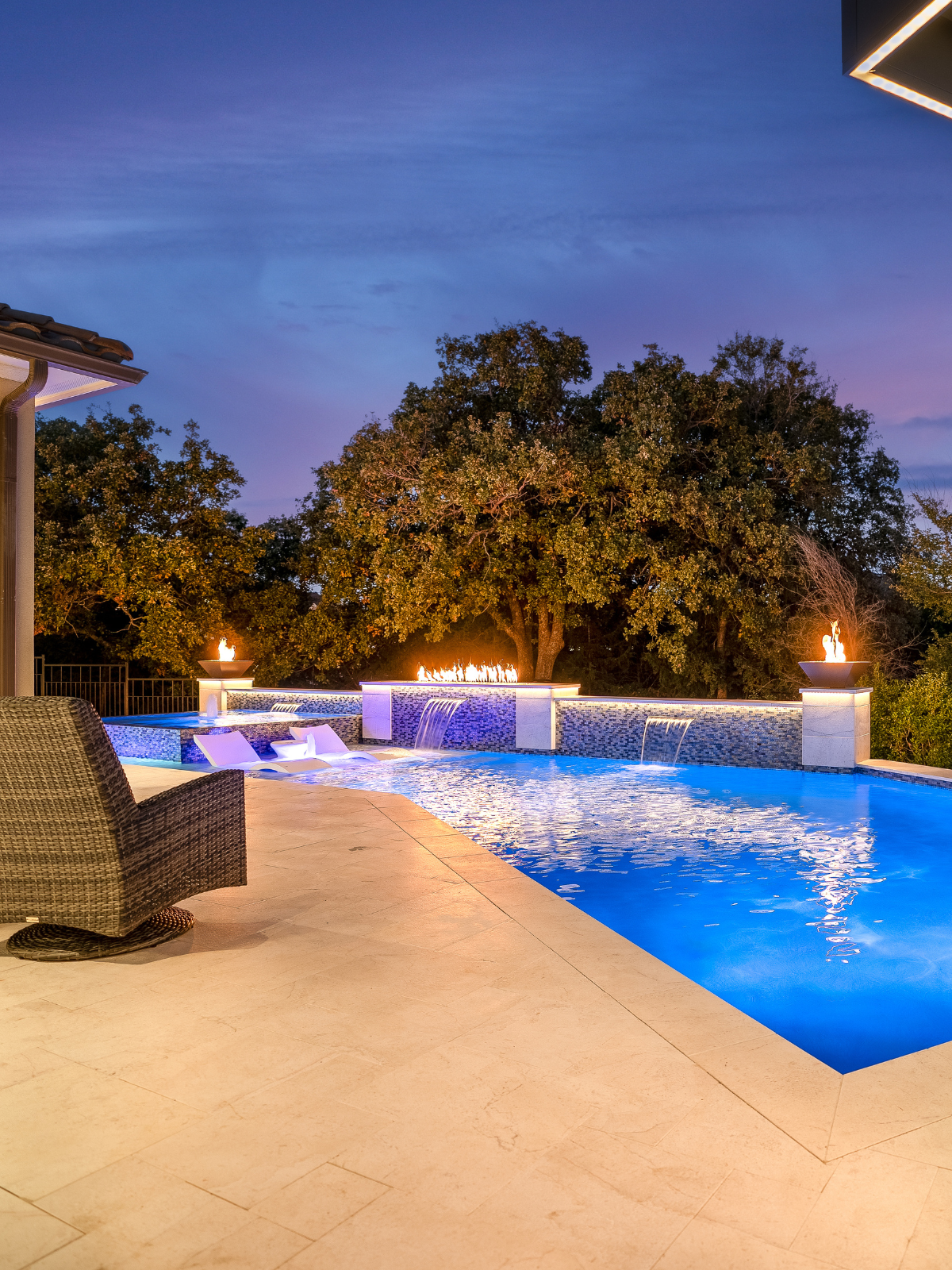
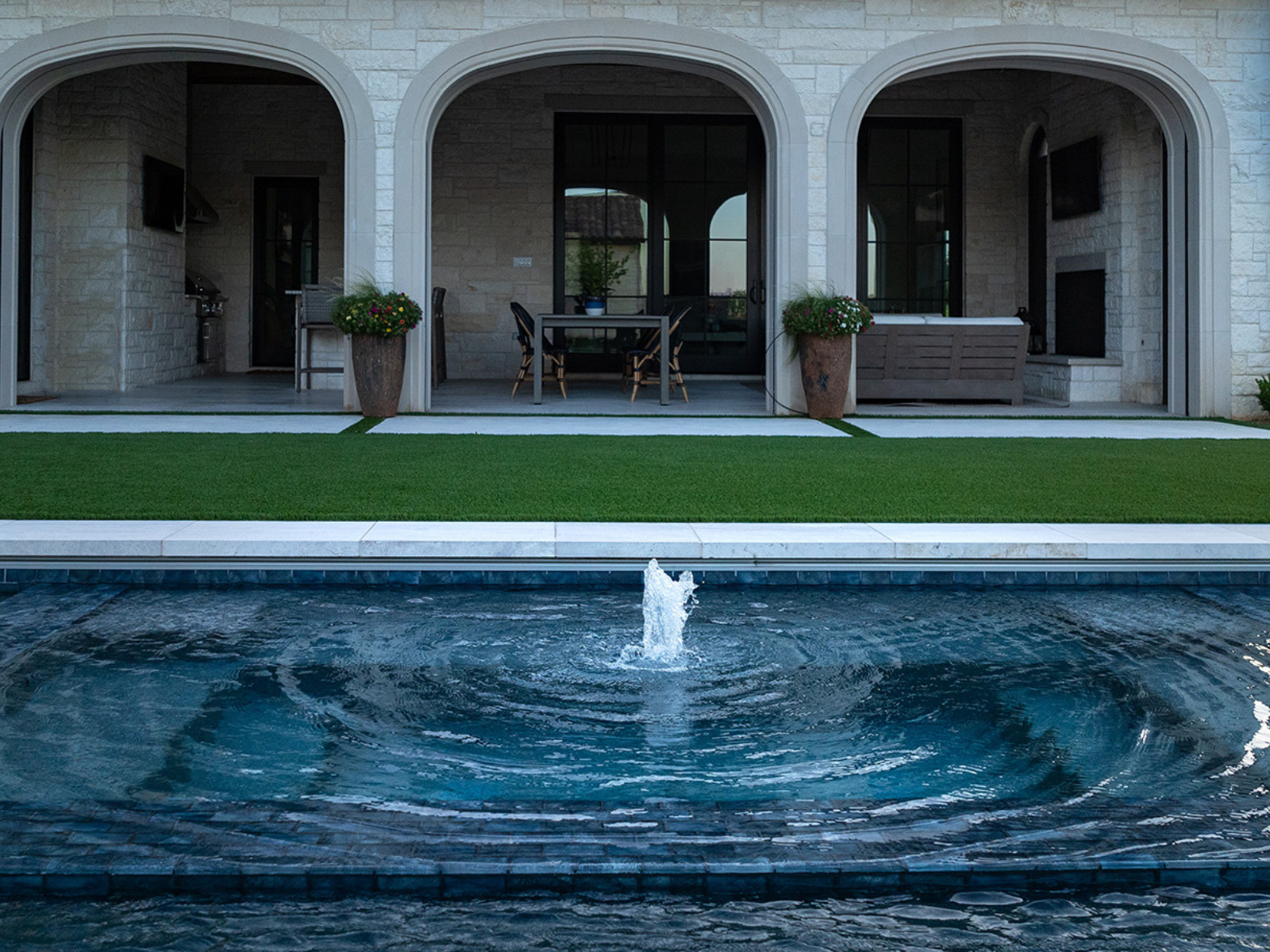


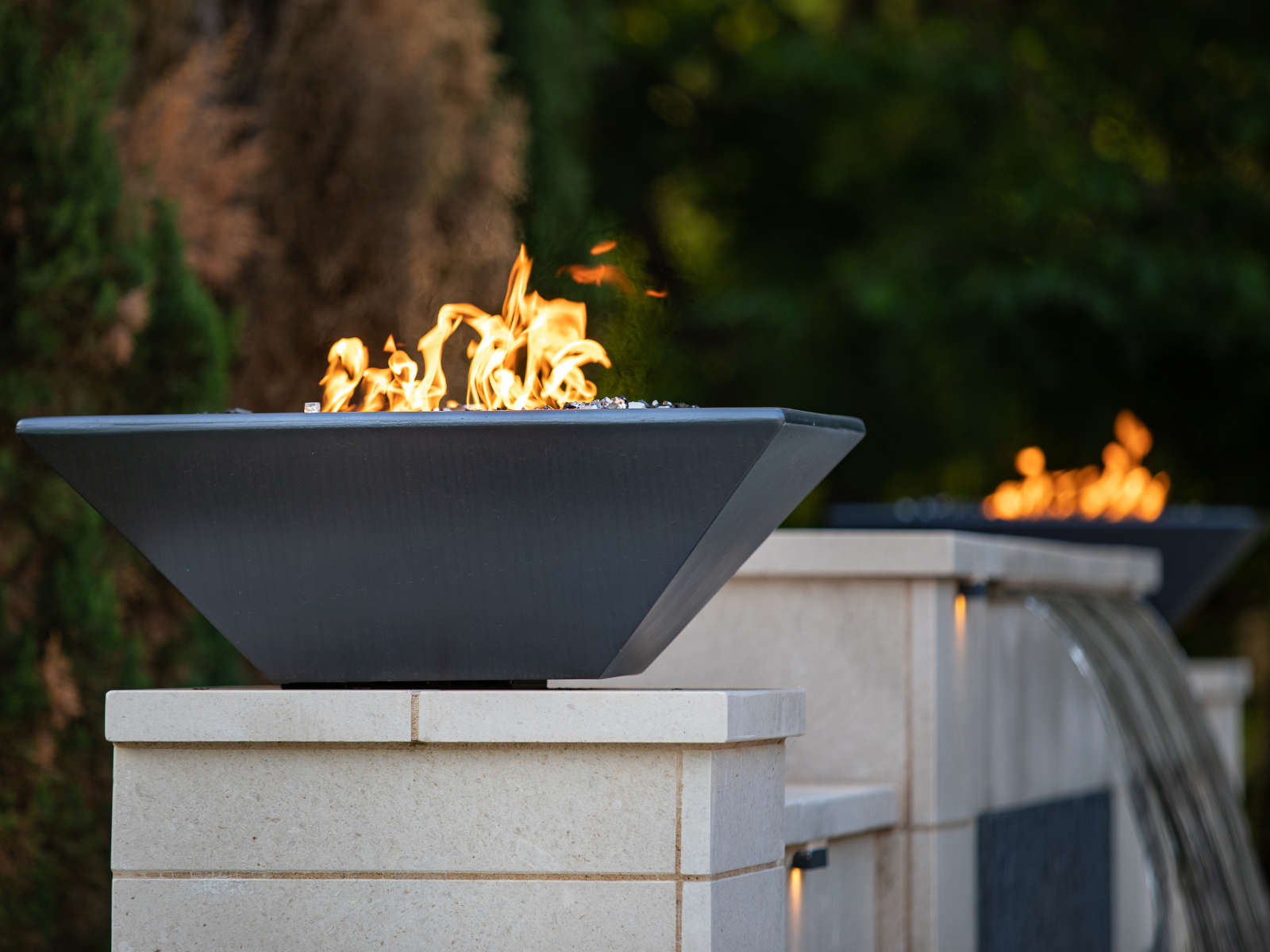
Watercrest's Design Styles in Fort Worth, TX
Fort Worth’s architecture doesn’t lean one direction the way a newer master-planned suburb does, so the right pool style here depends heavily on which pocket of the city a home sits in.
Modern pools tend to work best on Fort Worth’s newer custom builds, the kind increasingly common on Monticello’s rebuilt lots or in the Walsh growth corridor further west, where clean lines, dark plaster interiors, and minimal ornamentation complement contemporary or updated-traditional architecture rather than fighting it. Explore our modern pool gallery.
Transitional pools are the more common request on Fort Worth’s older, tree-canopied west-side lots, where a home’s Craftsman, Tudor, or Spanish Eclectic detailing calls for something softer than a strict modern box. Warm natural stone, relaxed water features, and organic-edged shapes read as an extension of a century-old streetscape instead of a modern insertion into it. See our transitional pool gallery.
Custom Pools Designed & Built for The Fort Worth Lifestyle
Fort Worth’s luxury buyer isn’t necessarily chasing a glass-tower skyline view. They’re much more likely to be choosing a half-acre lot with mature oak trees five miles from downtown, or a guard-gated address wrapped around a country-club fairway. Either way, they want a backyard that feels like private resort grounds rather than a suburban add-on. That’s true whether the home dates to 1911 or broke ground last year, and it’s the throughline connecting every Fort Worth neighborhood profiled below.
Fort Worth's Distinct Luxury Neighborhoods & Watercrest Pools
Fort Worth doesn’t have one luxury identity the way a smaller, newer suburb does. It has at least three distinct pockets: the old-money west side (Rivercrest, Crestline, Berkeley Place, Park Hill), the guard-gated golf world southwest of downtown (Mira Vista), and the far-west growth corridor still building toward its own luxury tier (Walsh). Each calls for a different design conversation.
Westover Hills
Westover Hills is its own incorporated town, not technically part of Fort Worth, but it’s completely surrounded by the city about five miles west of downtown and functions as its most exclusive address in every practical sense. It’s home to roughly 277 estates on half-acre to full-acre lots, with median list prices reported around $2.3M in mid-2026. The town runs its own police department and town hall, and homes here favor architect-designed, understated old-wealth exteriors: curved driveways, arched entries, deep setbacks under mature tree canopy.
On lots this large and this flat, a formal, symmetrical pool and pool-house program reads as private resort grounds rather than a backyard feature, which is exactly the kind of project this neighborhood calls for.
Mira Vista
Southwest of downtown along the eastern shore of Benbrook Lake, Mira Vista is a 24-hour guard-gated community built around Mira Vista Country Club’s 18-hole golf course, with a clubhouse, fitness center, and eight tennis courts. Recent sales data shows median prices trending upward, from roughly $1.4M six months ago to around $2.0M more recently, so we present this as a fast-moving market rather than a settled figure.
Every lot here borders either the golf course or the lake, which shapes the pool conversation directly: designs that compete with a fairway or water view read as a mistake, while negative-edge and vanishing-edge treatments that let the pool’s water line dissolve into the golf-course backdrop consistently work best. The guard gate also means construction scheduling and material delivery coordination matter more here than in an unrestricted neighborhood, and it’s something our crews plan around from day one.
Rivercrest
Rivercrest dates to the early 1900s and centers on River Crest Country Club, which opened in 1911 and is Fort Worth’s oldest country club. Homes here average roughly $2M and up, at around $441 per square foot, on large lots with the kind of mature-tree canopy only a century of growth produces. It isn’t a gated community; the prestige comes from pedigree and permanence rather than a guard house.
Because so many lots carry century-old landscaping and established grade, pool design here tends to work best at a smaller footprint with high-craftsmanship finishes, natural stone coping, and classic geometric lines rather than a massive, feature-heavy layout that would crowd the existing trees.
Crestline
Crestline sits adjacent to Fort Worth’s Cultural District, home to the Kimbell and The Modern Art Museum, and is known for Tudor, Spanish, and contemporary estates on hilly, tree-shaded lots. Average household income in the neighborhood runs well above the national average, and several of its larger estates sit close enough to River Crest Country Club to share its prestige without carrying its membership requirement.
The hillside topography that defines Crestline is actually a design opportunity: retaining walls, tiered decking, and elevation-change features like spillover spas and raised view decks turn a sloped lot into an asset instead of a construction obstacle.
Berkeley Place
Berkeley Place was annexed by Fort Worth in 1922 and was originally planned as a neighborhood for the city’s professional class; most homes date to the 1910s through 1930s in Craftsman, Prairie, and Tudor styles. There’s no golf course or gate here, the value is entirely architectural pedigree and tree canopy.
Many homes still have their original detached garages or guest cottages, once servants’ quarters, which means a pool project frequently has to design around existing outbuildings and a genuinely smaller historic lot. That constraint calls for restraint: a compact, well-detailed pool that respects the original architecture reads far better here than a design that maximizes square footage at the expense of the lot’s historic character.
Park Hill
Just south of the Fort Worth Zoo and near TCU, Park Hill is known for winding, tree-canopied streets and early-20th-century Tudor Revival, Mediterranean, and Craftsman homes, with distinctive stone bridges and lampposts that function as the neighborhood’s signature streetscape elements.
That strong shared visual identity matters for pool design: material choices, natural stone, wrought-iron accents benefit from echoing the neighborhood’s existing vernacular rather than introducing something visually unrelated, both for HOA review and for how the finished project reads to neighbors walking by.
Overton Park
Overton Park is a quieter, mid-century pocket, with most homes built between 1955 and 1968 on large lots along the Trinity Trails corridor; the median home price runs around $1M. The architecture here is clean-lined ranch rather than historic Craftsman or Tudor, and that pairs naturally with rectilinear pool geometry: a classic rectangle or clean geometric shape with minimal ornamentation complements a mid-century home far better than a free-form lagoon-style design would.
Formal Estate Design
Designed & Built by Watercrest Pools
Fort Worth’s old-money west side has driven renewed demand for formal pool programs: symmetrical or rectangular layouts, tiled spillways, perimeter overflow edges, and elegant natural stone coping with wrought-iron accents. It’s the natural fit for a Rivercrest or Westover Hills estate, where the surrounding architecture and landscaping have already committed to a formal, established language and the pool needs to match it rather than introduce a competing style. View our formal pool gallery.


Pool Trends & Features Popular with Fort Worth Homeowners Today
Wellness Integration
Cold plunge pools, swim-up bars, and hydrotherapy spas continue to be the most-requested upgrade across Fort Worth’s larger estate lots, particularly where a homeowner already has the square footage to dedicate a section of the yard entirely to recovery and fitness rather than pure entertaining.
Modern Automation
App-controlled heating, lighting, and water features are now a baseline expectation rather than an upsell, especially among Mira Vista and Westover Hills buyers accustomed to whole-home automation systems already running their properties.
Premium Natural Finishes
Natural stone coping, Pebble Sheen and glass-bead interior finishes, and travertine decking dominate requests on Fort Worth’s historic west side, where a pool has to visually belong next to a century-old home rather than look like a recent addition.
Fort Worth Pool Renovation & Remodeling
Renovation asks something different of a pool contractor than new construction does. Reworking an older gunite shell in a community like Mira Vista means matching new tile and coping to architecture that has already settled, upgrading equipment without tearing up an established landscape, and knowing which changes the architectural review will actually accept. Our renovation team handles resurfacing, retiling, added spillways and sun shelves, and full automation upgrades across Fort Worth.
A meaningful share of our Fort Worth work isn’t new construction at all. The city’s older west-side neighborhoods, Rivercrest, Crestline, Berkeley Place, and Park Hill among them, carry a real inventory of pools built in the 1970s through 1990s that are due for more than a surface fix: aging gunite shells, cracked or dated tile, and pool equipment that predates modern energy-efficiency standards by decades.
Watercrest’s luxury pool renovation work covers full resurfacing and retiling, adding a tanning ledge, sun shelf, or water and fire feature to a pool that was never designed with one, and converting older chlorine systems to saltwater. In Mira Vista specifically, we also see renovation requests tied to HOA-driven resurfacing and finish standards that come with living in a guard-gated country-club community, where the architectural review board expects a pool’s finish to stay current with the neighborhood’s overall standard.
Further west, in newer pockets like Walsh, renovation demand looks different: these are five- to ten-year-old pools where the ask is usually modernizing equipment and automation rather than replacing worn structural finishes. Either way, a renovation project gets the same senior-builder attention as a new build, not a lesser tier of service.
Understanding Fort Worth's Unique Pool Construction Challenges
Pool installation in Fort Worth is not a matter of dropping a shell into a hole. The Trinity River corridor, the city’s expansive clay, and the tree-preservation rules attached to its older lots each impose constraints before the first shovel moves. We plan the pier schedule, the drainage, and the equipment access around those conditions rather than against them.
Soil and Site Conditions
Fort Worth generally sits across two different soil zones: Blackland Prairie’s expansive clay to the east, and the Cross Timbers/Grand Prairie zone to the west, where limestone and rockier ground become more common. That’s the same part of the city, including Mira Vista, Westover Hills, and the Walsh corridor, where much of Fort Worth’s newer luxury construction is happening. Shallow limestone and chalk can complicate excavation in ways a generic clay-soil assumption doesn’t capture, and our crews plan foundation and shell engineering around whichever condition a specific lot actually presents.
Our potential solutions:
- Site-specific geotechnical assessment before excavation begins, not a generic DFW clay assumption
- Engineered steel and gunite shell design calibrated to the site’s actual bedrock or clay profile
- Coordination with excavation equipment and timelines suited to limestone conditions where they apply
Drainage and the Trinity River Corridor
Neighborhoods closer to the West Fork Trinity River corridor running through central Fort Worth can carry silty, alluvial soil with higher moisture retention and poorer compaction than the clay found elsewhere in the city. This is a legitimate engineering consideration distinct from the standard DFW drainage conversation, and one we account for on any lot near the river corridor.
Our solutions, where necessary:
- Enhanced perimeter drainage systems calibrated for higher-moisture soil conditions
- Grading plans that route water away from both the pool structure and the home’s foundation
- Site-specific compaction testing before construction begins on river-adjacent lots
Historic Lot and Tree Preservation Constraints
Berkeley Place, Park Hill, and Crestline all carry genuine early-20th-century tree canopy and, in some cases, historic-district review expectations. Protecting mature trees and respecting a smaller historic lot’s existing footprint calls for a different construction approach than a newer, larger suburban lot.
Our approach:
- Root-protection planning around mature trees identified before excavation
- Compact-footprint pool designs that work within a historic lot’s real constraints
- Direct coordination with neighborhood architectural review processes where they apply
HOA and Architectural Review Standards
Mira Vista’s guard-gated community operates with country-club-level architectural review, while Westover Hills, as its own incorporated town, has its own permitting and review processes entirely separate from the City of Fort Worth’s.
Our solutions:
- Direct experience navigating both municipal and private country-club review processes
- Pre-application material and design consultations to avoid review delays
- A single point of contact managing every approval step through completion
Learn More About Our Design Process
2026 Pool Design Trends in Fort Worth
Looking ahead, Fort Worth’s pool trends continue to split along the same lines as its neighborhoods: formal, symmetrical designs on the old-money west side, golf-course-sensitive negative-edge treatments in Mira Vista, and increasingly modern, clean-lined designs on the city’s newer custom infill lots in Monticello and the Walsh corridor. Wellness features, cold plunges, swim-up bars, hydrotherapy spas, and smart automation are showing up across every price point and every neighborhood, regardless of which architectural era the home itself belongs to.
Why We're the Best Custom Pool Builders in Fort Worth
Over 18 Years of North Texas Expertise
Since 2007, Watercrest has completed 500+ custom pools across the DFW Metroplex, bringing that experience to bear on Fort Worth’s genuinely wide range of lot conditions, from century-old estate grounds to brand-new custom infill.
Headquartered Just Up the Road in Southlake
Our design studio, headquartered in Southlake, keeps us closely connected to the wider Tarrant County market, including the same soil conditions and permitting relationships we rely on for projects in Keller and Westlake.
Quality Over Quantity
We’re privately and locally owned, not a builder that’s sold to corporate or private-equity ownership. Senior builders cap their active projects so your Fort Worth luxury pool build gets the attention it deserves.
Fluency Across Every Fort Worth Neighborhood
From a guard-gated Mira Vista golf lot to a century-old Rivercrest estate to a rebuilt infill lot in Monticello, we understand how to scale a design to genuinely different site conditions, not just different architectural styles.
One team accountable from design through installation.
The people who draw your pool are the same people answerable for how it gets built, and capping each senior builder at ten active projects is what keeps that promise from thinning out.
Ready to Build Your Fort Worth Dream Pool?

Whether you’re on a half-acre estate lot in Westover Hills, a guard-gated fairway lot in Mira Vista, or a century-old tree-canopied street in Rivercrest, Watercrest Pools brings the same craftsmanship and local knowledge to every Fort Worth project.
Contact us today to schedule your design consultation.
Watercrest Pools
Fort Worth’s Premier Custom Pool Builder
📍 580 Commerce Street, Suite 140, Southlake, TX 76092
📞 (817) 431-8997
🌐 watercrestpools.com
✉️ info@watercrestpools.com
Locations We Serve
Serving All of DFW Metroplex
Each community has unique architectural styles, neighborhoods and lot characteristics. We customize every pool design to complement your specific property and neighborhood aesthetic. From the sprawling estates of Westlake to the family-oriented neighborhoods of Frisco, we understand what makes each area special.
Flower Mound
Sherman
Celina
Anna
Highland Village
Lewisville
Coppell
Plano
Allen
McKinney
The colony
Little Elm
Denton
Double Oak
Roanoke
Haslet
Watercrest Pools
ADDRESS
580 Commerce St. Suite 140
Southlake, Texas 76092
PHONE
817-431-8997
info@watercrestpools.com
HOURS OF OPERATION
Mon–Fri: 9:00am – 5:00pm
Sat–Sun: Closed
SOCIAL MEDIA


